How Hot Does an Electric Kettle Get?
A standard electric kettle heats water to about 212°F (100°C) at sea level, the boiling point, then switches off. Kettles with tea presets stop lower, from about 160°F to 200°F, so delicate leaves don't scorch.
On this page (9 sections)
- How hot does a basic electric kettle get?
- Why does the kettle stop at the boiling point?
- What temperatures do tea presets use?
- Do I need a kettle with temperature control?
- How does altitude change the numbers?
- How hot is the water when it leaves the spout?
- How does a kettle compare with a microwave for heating water?
- How do scale and hard water affect kettle temperature?
- What temperature should you actually pour at?
A standard electric kettle heats water to about 212°F (100°C) at sea level, the boiling point, then switches off. Kettles with tea presets stop lower, from about 160°F to 200°F, so delicate leaves don't scorch.
That gap matters more than most people expect. The answer to how hot does an electric kettle get depends on whether yours has one fixed target or a set of buttons you can choose from.
How hot does a basic electric kettle get?
A plain kettle without presets heats water until it boils, roughly 212°F (100°C) at sea level, then cuts power. There's no lower setting to pick, so every pour starts at the same temperature.
The steam switch is what stops it. Steam rises through a channel in the handle, and when it gets hot enough, a thermostat trips and breaks the circuit.
That's why a kettle left on won't keep boiling dry, and why the water settles just at or slightly past the boil before the switch reacts.
The exact number shifts with your kitchen. Altitude is the big one: water at 5,000 feet boils near 203°F, and at 8,000 feet it's closer to 197°F.
A kettle still does its job, but "boiling" is cooler water than at sea level.
Altitude aside, a basic kettle is the right tool when you want a rolling boil for pasta, instant noodles or a French press. It's less useful when you want a gentler pour for green tea.
Why does the kettle stop at the boiling point?
The kettle stops because a steam sensor trips once the water reaches a full boil. That's a safety design, not a brewing choice.
Boiling water is the most predictable end point a simple thermostat can detect.
Heat rises through the element at the base, and the water churns as it approaches the boil. Once steam escapes past the lid area, the sensor in the handle registers it and shuts the element off.
The kettle never "knows" the number on a dial; it reacts to steam.
That's also why a kettle with a blocked steam channel can keep running. Keeping the lid closed and the water below the max line helps the sensor do its job.
If you want a temperature below boiling, the kettle has to be built with a thermostat that targets it. That's the whole difference between a basic kettle and a variable one.
What temperatures do tea presets use?
Tea presets run from about 160°F to 200°F, each tuned to a tea type. They exist because different leaves release their flavor at different heat levels, and boiling water can turn a delicate cup bitter.
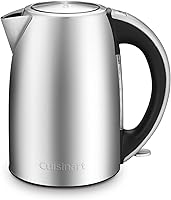
The Cuisinart CPK-17P1 PerfecTemp shows the pattern clearly. Its six settings are 160°F for delicate teas, 175°F for green tea, 185°F for white tea, 190°F for oolong, and 200°F for French press coffee, plus a full boil for black tea or cocoa.
That spread covers most of what a tea drinker needs. A 160°F pour suits the lightest white and green leaves, while a 200°F setting gives coffee grounds enough heat to extract properly without a rolling boil.
If you brew mostly black tea or use the kettle for cooking, a boil button is what you'll reach for. If you switch between green and black tea through the day, the preset buttons save you from guessing.
Do I need a kettle with temperature control?
A temperature-control kettle is worth it if you brew green, white or oolong tea regularly. For black tea and instant drinks, a basic kettle at a full boil does the job just as well.
The difference is repeatability. With presets, every cup of green tea starts at the same 175°F, so you can adjust your leaf amount and steep time against a steady baseline.
Without them, you're waiting and guessing, or pouring boiling water and hoping the tea survives.
Our guide to electric tea kettle temperature control covers the models and what each preset range offers. It's the place to start if you want a kettle built around brewing rather than just boiling.
One trade-off: preset kettles cost more and have more parts to clean. The heating element, thermostat and keep-warm circuit all add complexity compared with a simple on-off kettle.
How does altitude change the numbers?
At higher altitude, water boils at a lower temperature, so a kettle's top temperature drops with it. The gap is small at low elevations and grows as you climb.
The rough rule is about 1.8°F lower boiling point for every 1,000 feet above sea level. At 3,000 feet that puts the boil near 207°F, and at 6,000 feet near 201°F.
A preset set to 200°F is still accurate; the boil setting just gets there sooner.
This matters for baking and cooking more than for tea. A recipe that assumes a rolling boil at 212°F may need longer at altitude.
For tea, the preset temperatures are the ones to trust, since they're set by thermostat, not by steam.
If your kettle has no presets, an instant-read thermometer is the easiest way to confirm what "boiling" means in your kitchen.
How hot is the water when it leaves the spout?
The water is essentially at the kettle's set temperature as it pours, losing a few degrees on the way to the cup. The drop is small over a short pour but grows with a wide spout or a long stream.
Most of the heat loss happens in the cup, not the kettle. A cold ceramic mug pulls warmth out of the water quickly, so pre-warming the mug keeps your brew closer to the target temperature.
A thin-walled glass loses heat faster than a thick stoneware mug.
The pour itself matters too. A slow, steady pour from a narrow spout keeps the stream together and loses less heat than a wide, splashing pour.
That's part of why gooseneck kettles are popular for pour-over coffee.
If you're brewing a delicate tea, pour soon after the kettle stops. Water held in a preset kettle's keep-warm mode stays close to its setting, but a kettle without that feature cools steadily once it shuts off.
How does a kettle compare with a microwave for heating water?
A kettle heats water faster and more evenly than a microwave for tea and coffee. A microwave can leave hot and cold spots, while a kettle's element heats the whole body of water as it churns.
The Cosori Electric Kettle heats 0.5L in under 3 minutes, according to the brand. That's quicker than most microwaves for the same volume, and the result is a consistent temperature rather than a mix of hot and cool patches.
A microwave is still handy for reheating a mug of tea that's gone cold. But for starting a fresh cup, a kettle gives you a more predictable result.
Our comparison of electric kettle vs microwave breaks down the speed and taste differences in more detail.
The kettle also stops at a set point, so you don't risk superheating water past boiling. A microwave can push water beyond its boiling point in a smooth cup, which is why stirring before you remove it matters.
How do scale and hard water affect kettle temperature?
Limescale buildup on the element slows heating and can make the kettle shut off early. Scale acts as insulation between the element and the water, so the element runs hotter while the water warms more slowly.
The Cuisinart CPK-17P1 has a concealed heating element to limit mineral buildup and a removable scale filter. Those features help, but they don't remove the need for regular descaling in hard-water areas.
A descaler makes the job easier than scrubbing. The Durgol Universal Multipurpose Descaler is a sulfamic-acid solution the brand says breaks down tough limescale and leaves no residue or aftertaste.
Follow the kettle's own cleaning instructions when you use it. A clean element heats faster and holds its temperature more steadily, which matters most for preset tea settings.
Our notes on electric kettle vs stove top kettle cover which type handles hard water more gracefully.
What temperature should you actually pour at?
Match the pour to the leaf: about 160°F for delicate teas, 175°F for green, 185°F for white, 190°F for oolong, 200°F for French press coffee, and a full boil for black tea. A full boil is for cooking and instant drinks.
The numbers on a preset kettle are a starting point, not a rule. If your green tea tastes bitter at 175°F, try 165°F next time.
If it tastes flat, move up toward 185°F. The leaf, its age and how much you use all shift the ideal point.
For anyone asking how hot does an electric kettle get, the short version is this: a basic kettle tops out at boiling, and a preset kettle lets you stop wherever your tea wants. Pick the preset model if you brew delicate leaves; a plain kettle is fine if you mostly make black tea or use it for cooking.
A quick thermometer check in your own kitchen settles the altitude question and confirms your kettle's settings. After that, the best guide is your own taste, cup by cup.
For a closer look at boil times before you buy, see how long an electric kettle takes to boil.
Frequently asked questions
Does an electric kettle always boil water?
No. A plain kettle without presets runs until the water boils and the steam switch cuts power.
A variable-temperature kettle lets you choose a lower target, so it stops warming before boiling and holds that heat for a while.
What temperature should I use for green tea?
Green tea brews best around 175°F. Water at a full boil scalds the leaves and turns the cup bitter, so a preset or a short rest after boiling gives you a gentler pour.
Does water boil at a lower temperature at high altitude?
Yes. The boiling point drops as air pressure falls, so water at 5,000 feet boils near 203°F instead of 212°F.
A preset tea temperature still works, but a plain kettle will shut off below a true sea-level boil.
Can I use a meat thermometer to check kettle water?
It works for a rough reading if the probe is rated for hot liquid. Stir the water first, because the top and bottom of the kettle can differ, and give the dial a moment to settle before you read it.