Does an Electric Kettle Consume More Electricity?
No, an electric kettle does not consume more electricity than most people assume. It pulls a high wattage while it runs, but it only runs for a few minutes, so a single boil uses very little energy.
On this page (10 sections)
- Does an electric kettle consume more electricity than people think?
- What actually drives a kettle's electricity use?
- Why does a kettle seem to use more power than it does?
- How much electricity does a kettle use per boil?
- Does a temperature-control kettle use more electricity?
- When does a kettle use more electricity than it should?
- Is an electric kettle cheaper to run than a stovetop kettle?
- Does kettle wattage change the energy cost?
- How do you keep kettle electricity use low?
- Verdict: is the kettle a heavy energy user?
No, an electric kettle does not consume more electricity than most people assume. It pulls a high wattage while it runs, but it only runs for a few minutes, so a single boil uses very little energy.
The confusion comes from the wattage number. A kettle heats water faster than almost anything else in the kitchen, and that speed is exactly why its total energy use stays low.
This guide breaks down what "does electric kettle consume more electricity" really means in practice.
Does an electric kettle consume more electricity than people think?
No. An electric kettle uses a high wattage for a short time, which keeps total energy low.
A 1500W kettle draws 1.5 kilowatts, and that only matters when you multiply it by the minutes it's actually on.
The math is simple. Power in kilowatts times time in hours gives kilowatt-hours, the unit on your bill.
A 1500W kettle is 1.5 kW, so a 3-minute boil uses 1.5 × 0.05, or about 0.075 kWh.
Compare that to a space heater left on for an hour. The heater draws 1.5 kW the whole time for 1.5 kWh.
The kettle did its job in a fraction of that. The high number on the box is not the number that hits your bill.
What actually drives a kettle's electricity use?
Three things decide how much energy a boil takes: the water volume, the wattage, and how long the kettle runs. Wattage sets the speed, but the volume and the runtime set the total.
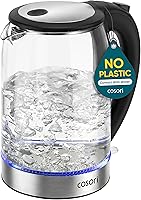
A 1500W element heats a set amount of water in a fairly predictable time. The Cosori Electric Kettle heats 0.5L, about 2 cups, in under 3 minutes.
Fill it to the 1.7L line and the same element needs far longer, so the energy climbs with the volume.
Runtime also includes anything after the boil. An auto shut-off stops the element when the water is ready, and the Cosori model shuts off within 30 seconds of a boil.
That quick cutoff is part of why the total stays modest.
Why does a kettle seem to use more power than it does?
A kettle looks power-hungry because it's fast. In a few minutes it can bring water to a rolling boil, while a stovetop pot takes much longer and heats the whole room around it.
The wattage label tells you how quickly the element converts electricity to heat. A 1500W element moves a lot of energy per minute, so the water is ready quickly.
Your meter records total energy, not peak draw.
This is also why the comparison in is an electric kettle more efficient often favors the kettle. An electric element sits inside the water, so almost all the heat lands where it's needed.
A stovetop pot sends heat into the air, the burner, and the pot walls.
How much electricity does a kettle use per boil?
A typical boil uses roughly 0.05 to 0.15 kWh, depending on volume and starting water temperature. A single cup sits at the low end, and a full kettle sits at the high end.
Cold tap water takes longer than water that's already warm. A full 1.7L boil on a 1500W kettle can run past 5 minutes, which pushes the total up.
Even so, it stays well under a quarter of a kilowatt-hour.
For a fuller breakdown by cup size and kettle type, see how much electricity does a kettle use. That guide puts the same math into a per-boil table you can check against your own routine.
Does a temperature-control kettle use more electricity?
Not by itself, and it can use less if it stops short of a rolling boil. A temperature-control kettle heats to a set point, so green tea at 175°F needs less energy than a full 212°F boil.
The Cosori Stainless Temperature Kettle 1.7L gives five one-touch presets: Boil, Black Tea, Oolong Tea, Green Tea, and Coffee. It also adjusts in 5°F steps from 105°F to 212°F.
Brewing at a lower preset means the element switches off sooner.
That preset range suits tea drinkers who want a specific temperature rather than a rolling boil. The all-metal interior keeps plastic out of the water path, which matters if you brew daily.
Keep-warm is where the energy question changes, though.
A 60-minute keep-warm setting holds heat and draws power while it's active. Use it when you'll refill within the hour, and switch it off when the pot is empty.
When does a kettle use more electricity than it should?
A kettle uses more energy when you boil more water than you need, run keep-warm for long stretches, or let scale build up on the element. Each one adds minutes or watts to the same task.
Overfilling is the most common cause. Boiling 1.7L to make one cup wastes the energy used to heat the rest.
Use the internal water level indicator on the Cosori Stainless model to fill only what you'll pour.
Scale is the second. Hard water leaves calcium on the element, and a coated element takes longer to pass heat into the water.
A descaler keeps the heating surface clean so the kettle runs at its normal rate.
The Durgol Universal Descaler removes limescale and calcium buildup and works on kettles as well as coffee machines. It's made from sulfamic acid rather than citric acid, and Durgol says the formula handles tougher buildup.
Read the appliance manual for the correct dose before you use it.
Is an electric kettle cheaper to run than a stovetop kettle?
Usually yes, because an electric kettle puts more of its energy into the water. A stovetop kettle heats through a burner and a pot base, and a lot of heat escapes around the sides.
The gap is largest on a gas stove, where much of the flame heats the air. An electric element sits in direct contact with the water, so the losses are smaller.
That's why the efficient option is the one that heats the water directly.
The gap shrinks if you already have an induction hob, which transfers heat well. It also shrinks if you boil a full stovetop pot for a single cup.
In both cases, matching the water volume to the job matters more than the appliance.
Does kettle wattage change the energy cost?
Wattage changes the speed, not the total energy for the same volume. A 3000W kettle boils a cup in about half the time of a 1500W model, so the kilowatt-hours land close to the same.
Think of it as filling a bucket. A wider hose fills it faster, but the bucket still holds the same amount.
The energy needed to raise a set volume of water to boiling doesn't change with the element size.
Where wattage matters is your time and your circuit. A higher-wattage kettle needs a socket that can carry the load, and it heats faster for people in a hurry.
The Cosori Electric Kettle at 1500W heats 2 cups in under 3 minutes, which is quick enough for most kitchens.
How do you keep kettle electricity use low?
Boil only what you need, use a preset instead of a full boil when the drink allows, and descale on a schedule. These three habits cut the energy per cup more than any appliance swap.
Follow the steps in how to use an electric kettle to fill, switch on, and pour without waste. Fill to the cup line, not the max line, and let the auto shut-off do its job.
If you brew loose leaf, an electric kettle with infuser lets you steep in the same vessel and skip a second boil. Fewer boils means less total energy across the day.
Verdict: is the kettle a heavy energy user?
No, an electric kettle is one of the lighter appliances in a kitchen when you boil sensible amounts. The high wattage is a speed feature, and the short runtime keeps the total energy small.
For most households, the real savings come from habits rather than hardware. Fill to the cup, skip the long keep-warm, and descale when the element looks cloudy.
Do those three things and the question of whether an electric kettle consumes more electricity stops being a worry, because each boil stays cheap.
If you want the preset control that makes smaller boils easy, the Cosori Stainless Temperature Kettle 1.7L is the pick here. For a simple daily boil with a wide mouth and auto shut-off, the Cosori Electric Kettle covers it as the simpler, lower-priced option.
Either way, the kettle is not the appliance to blame for a high bill.
Frequently asked questions
Does a 1500W kettle use a lot of electricity?
A 1500W kettle draws 1.5 kilowatts while it's heating. A 3-minute boil uses about 0.075 kWh, which is a very small amount of energy overall.
Is it cheaper to boil water in a kettle or on the stove?
A kettle usually heats water for less energy because more of the heat goes into the water. A stovetop pot loses heat around the sides and into the air.
Does keeping a kettle warm use electricity?
Yes, a keep-warm setting holds the temperature and draws power to do it. The longer it stays on, the more energy it uses, so switch it off when you're done.
Does a full kettle cost more to boil than a half-full one?
Yes. Heating more water takes more energy, so a full 1.7L kettle uses more electricity than boiling just the cup or two you need.
Does limescale make a kettle use more electricity?
Scale buildup can slow heat transfer and make the kettle work longer. Descaling regularly helps the element heat water at its normal rate.